CURRENT RESEARCH PROJECTS
We study element cycling in ecosystems, and we are most interested in studying how the form, magnitude and timing of carbon, nutrient and contaminant imports and exports are shifting in response to rapid environmental change. Our tools work anywhere, and currently we apply them in rivers, wetlands and watersheds stretching from the White Mountains of New Hampshire to the Peruvian Amazon. We also love data synthesis and collaborations which allow for upscaling and for expanding our scope of inference beyond the bounds of any individual study. Below we describe current research in the lab.
RiverGas: Understanding the Timing, Magnitude and Sources of the Gas Rivers Pass (NSF Macrosystems)
|
New Hope Creek in the Duke Forest. Photo by ES Bernhardt
|
Bernhardt and Amanda DelVecchia (UNC-CH) spearhead and postdoc Nick Marzolf drives this five year effort to examining the extent to which in-stream metabolism vs upslope contributions drive greenhouse gas emissions from rivers included in the National Ecological Observatory Network.
This projects builds off the recently completed StreamPULSE project that estimated the metabolic regimes of hundreds of rivers across the world. Learn more about the StreamPULSE project, explore or make use of all of our data, and view all of our protocols at data.streampulse.org Lab alumni Alice Carter, Phil Savoy, and Aaron Berdanier conducted their research as part of the StreamPULSE project. Former PhD students Elizabeth Sudduth and Joanna Blaszczak and former postdoc Tim Covino each invested much of their time in the lab studying stream ecosystem metabolism and gas exchange. |
Macrosheds: Enabling macroscale watershed science (NSF Macrosystems)
|
|
Bernhardt and Matt Ross (CSU) are co-PIs of this five year grant aimed at collating and analyzing watershed ecosystem study data from every long-term watershed study in the United States. Our goal is to massively increase access, use and analysis of watershed ecosystem data by building high powered data infrastructure and visualization tools and training the next generation of watershed scientists through our macroscale watersheds training camps. Mike Vlah, Spencer Rhea, and Wes Slaughter are the data scientists for this project. Post-doctoral researchers Amanda DelVecchia and Nick Marzolf, and PhD student Audrey Thellman are launching the research initiative as we move into the analysis phase of this project.
Check out the MacroSheds data portal to play with data from dozens of watershed studies. Screen shot at left shows 57 years of water chemistry and flow data from the reference watershed at Hubbard Brook. |
Coastal Ecosystem Impacts of Saltwater intrusion and Sea Level Rise (NSF Coastal SEES, NASA, Seagrant)
|
Ghost Forest, Marcelo Ardon checks SETS, Emily Ury measures salinity. Coastal NC 2019. Photos by ES Bernhardt
Learn more about our coastal work at our Coastal SEES project website
|
Bernhardt is collaborating with Duke's Justin Wright and Ryan Emanuel, NCSU's Marcelo Ardon, and UNC's Todd BenDor in a five year project to estimate the extent of saltwater intrusion and saltwater intrusion vulnerabilities for North Carolina's coastal forested wetlands. In addition to quantifying the rate of forested wetland loss and the formation of ghost forests, we are interested in understanding how soil carbon stocks and greenhouse gas emissions are affected during these rapid ecosystem transitions.
In collaboration with UVA's Xi Yang and former postdoc Elliott White (now an assistant professor at Stanford), Emily is leading a two year "Coastal Margins" working group aimed at bringing research groups together from throughout the US coastal plain (Cape Cod to the Gulf coast of Texas) to synthesize our current understanding, begin mapping and assessing the cumulative loss of freshwater wetlands and create a strategic plan for future, coordinated research efforts on this important topic. PhD student Emily Ury (now a Post Doc at University of Waterloo) measured the impacts of coastal salinization on the ground in large-scale salt addition experiments, in the air using drone based imagery and from space using satellite remote sensing. Lab alumni Jen Morse, Marcelo Ardon, Hayes Neely, Ben Riegel and Ashley Helton all conducted part of their research on NC coastal wetlands and global change. |
Long-term change in watershed ecosystems of the northeast (NSF LTER, NSF LTREB)
|
Hubbard Brook and Upper Paradise Brook, New Hampshire. Photos by ES Bernhardt
Learn about the sixty years of ecological research conducted in this northeastern forest by visiting the Hubbard Brook Ecosystem study website
Play with the long-term record of stream and precipitation chemistry through our data visualization app http://hbwater.org/ Want to learn more about our work on reaches downstream of HBEF? Check out Pemigewasset biological monitoring |
Bernhardt and Emma Rosi (Cary IES) are together in charge of maintaining the world's longest continuos streamwater and precipitation chemistry monitoring program. Since 1963, stream and precipitation samples have been collected every week from multiple streams and rain gauges in this beautiful valley within the White Mountains National Forest of NH. In the past, these data were used to document the existence of acid rain and the efficacy of the Clean Air Act and Clean Air Act Amendment and were used to make the first watershed ecosystem estimates of mineral weathering and to document the impact of deforestation on nutrient losses from forest soils. In the coming decade of NSF LTREB funding we will be exploring how highly variable winter snowpack, shifting forest phenology and the legacy of acid rain are interacting to drive changes in the timing, magnitude and form of water and solute exports from these watersheds. Rosi and Bernhardt are also affiliated with the Hubbard Brook LTER program and, in 2017, initiated new data collection programs which will allow us to document long-term change in the productivity, carbon cycling and aquatic insect communities of these northeastern streams in response to climate change, disturbance and the legacy impacts of prior experiments and acid rain.
PhD student Audrey Thellman is reconstructing the long-term history of stream climate at HBEF using remote sensing data and is testing the constraints on stream productivity across the Hubbard Brook valley. Lab alumni Richard Marinos conducted his PhD research at HBEF. Bernhardt conducted her PhD research with Gene Likens in these streams. |
A City and Its River: Durham's Ellerbe Creek Watershed (Bass Connections)
|
Fall 2021 water synoptic survey of Ellerbe Creek in Durham, NC.
Analysis of samples are conducted in collaboration with economist Christopher Timmins, eco-toxicologist Nishad Jayasundara, and the co-PIs of the Duke Exposomics Lab, Heather Stapleton and Lee Ferguson |
Urban watersheds are dynamic ecological systems shaped by social, physical and ecological forces. A long history of systemic environmental racism and economic inequities has a destructive impact on biological diversity and human health in cities.
Lead by team leads Bernhardt, PhD candidate Jonny Behrens, Steve Anderson, and PhD candidate Sarah Raviola, the project merges fields of biology, environmental chemistry, urban ecology and social sciences to better understand how the distribution of ecological benefits and risks overlap with the distribution of economic and social capital of Ellerbe Creek watershed residents. The Ellerbe Creek watershed is Durham’s primary watershed and is closely intertwined with Durham and Duke’s East Campus. Over the course of the year, the graduate and undergraduate student team have mapped the distribution and ownership of greenspaces throughout the watershed, conducted multiple water synoptic sampling surveys throughout the Creek and its tributaries, and mapped the distribution of infrastructure, wealth, and racial demographics throughout the watershed. The team is collaborating closely with Ellerbe Creek Watershed Association to engage community stakeholders. |
Saltwater Intrusion and Sea Level Rise - Research Coordination Network (NSF DISES)
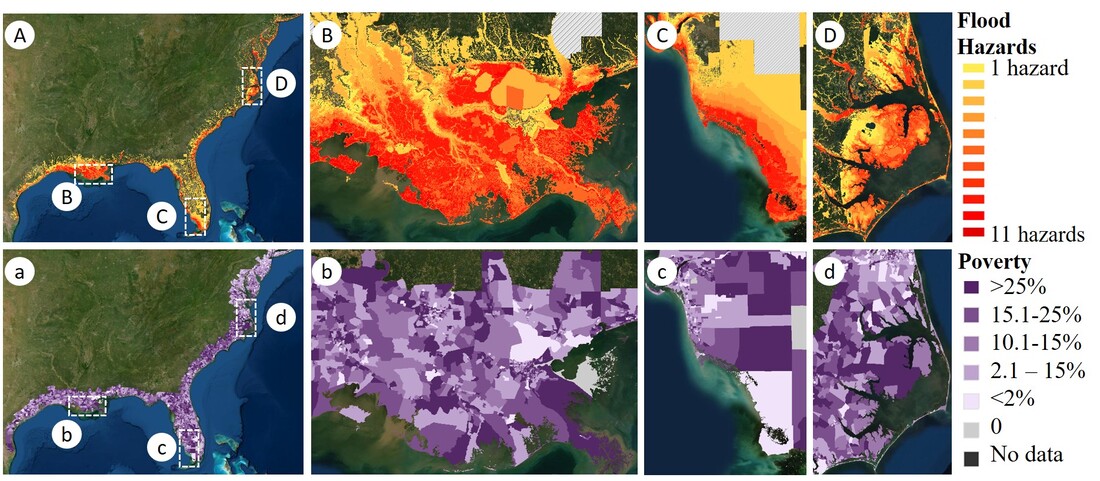
Ecosystem and Social vulnerabilities in the Coastal Plain ecoregion. This compilation of maps shows flood hazard (top) and poverty (bottom) for the (Aa) entire North American Coastal Plain, (Bb) Gulf Coast of Louisiana, (Cc) southwest coast of Florida, and (Dd) coast of North Carolina. All maps are from NOAAs Coastal Flood Exposure Mapper.
Want to learn more about the project and get involved? Visit the SWISLR website here: www.swislr.org/
|
This 3-year Research Coordination Network (RCN) is lead by the core team of Emily Bernhardt, Xi Yang, Ryan Emanual, and Kiera O'Donnell. The core team, along with a steering committee of 22 members, aim to bring those who focus on the issues surrounding SaltWater Intrusion and Sea Level Rise (SWISLR) together.
Nearly all of the North American Coastal Plain (NACP) is subject to rising sea levels, land subsidence, more severe hurricanes, and more intense droughts. The resulting SWISLR is rapidly altering the structure and function of coastal plain ecosystems and placing new constraints on coastal communities' economies and lifestyles. Specifically, the largely disadvantaged rural and small communities throughout the NACP are faced with significant challenges. Although many scholars and practitioners are engaged in studying and managing SWISLR impacts on social, economic, and ecological systems, current studies are localized and disconnected. Therefore, the primary focus of the SWISLR-RCN is to conduct convergence research by building a connective intellectual network and an integrated conceptual scaffolding to rapidly expand our capacity to forecast and prepare for SWISLR impacts throughout the rural communities of the NACP. |
PAST RESEARCH PROJECTS
Synthetic chemicals as agents of global change
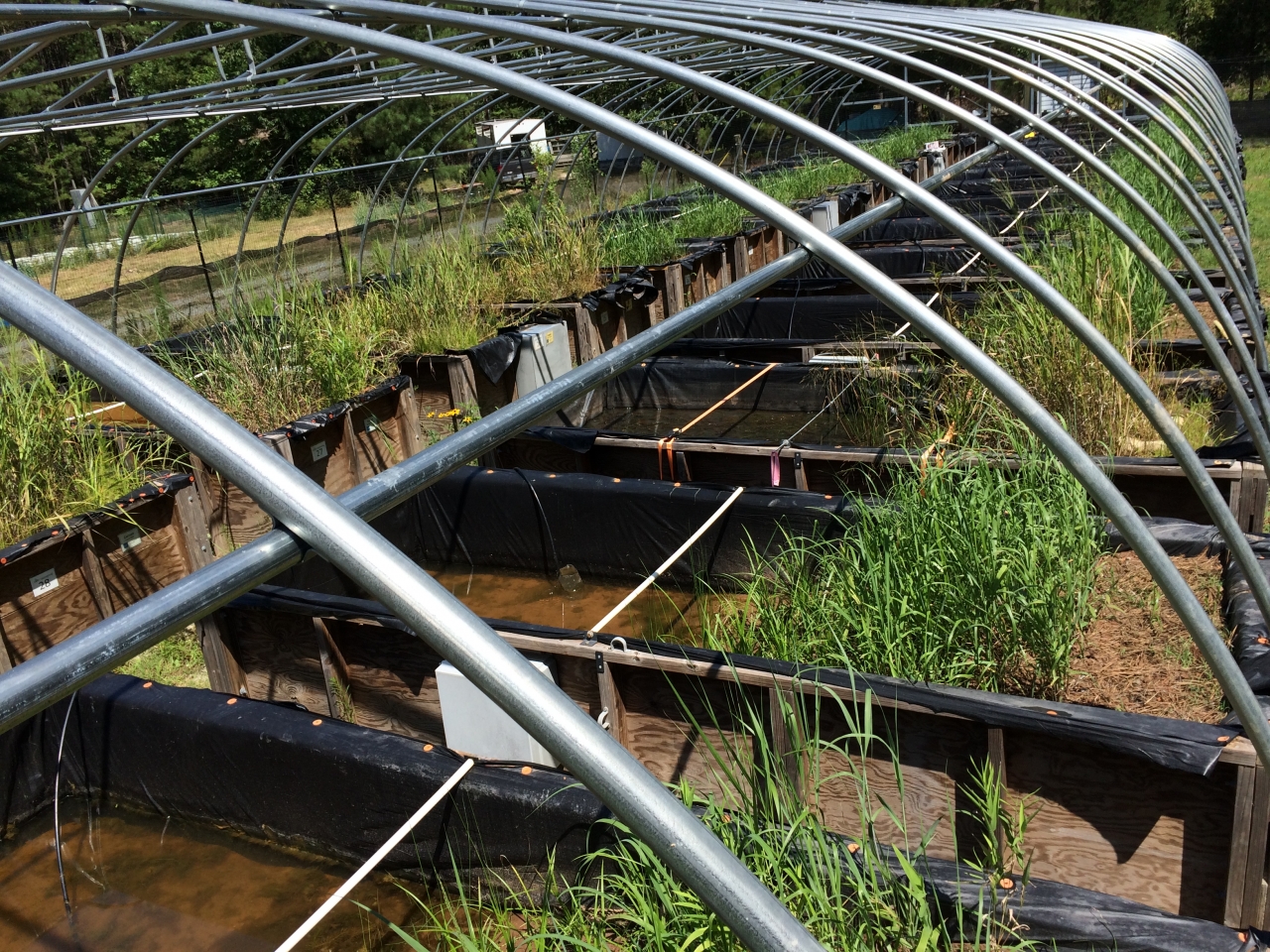
The Duke Forest wetland mesocosm facility where we have conducted numerous chemical exposure experiments. Photo by Steve Anderson.
|
An ever increasing diversity of synthetic chemicals are being added to the Earth's land surface at an exponentially increasing rate (Bernhardt et al. 2017). While harder to detect with the naked eye than land use change, the consequences of toxic substances and contaminant mixtures can have significant negative consequences for organisms and ecosystem processes. A variety of prior and current projects fall under this umbrella.
New work in the lab, led by PhD candidate Jonny Behrens, explores how urban stressors, including complex mixtures of contaminants from storm and wastewater, impact ecosystem processes. Research is on-going into the synchrony and asynchrony of metabolic regimes and secondary production in a storm and wastewater dominated stream relative to a forested watershed in the Piedmont region of NC. For a decade, Bernhardt was the Ecosystem Research Theme leader for the Center for the Environmental Implications of Nanotechnology. In work led first by Ben Colman (now at U Montana) and then Dr. Marie Simonin (now at INRE in Angers, France) we conducted a series of field mesocosm experiments to document significant consequences of nanomaterial exposure as a result of realistic, low-level, chronic release of several widely used nanoparticles. We have also had a longstanding interest in the chemical stressor mixtures in urban streams and in lakes receiving effluent from coal fired power plants with lab alumni Joanna Blaszczak, Jess Brandt and Ethan Baruch focused on this topic. |
Tracking mercury pollution from small scale gold mines into Amazonian forests (Bass Connections)
|
Gold Mine on the Madre de Dios, sampling transport, tree core collection - photos by ES Bernhardt
|
Within the last decade small scale gold mining (often referred to as artisanal gold mining) has become the dominant source of global atmospheric mercury pollution. Most of this activity is illegal but poorly regulated and is taking place throughout developing nations of the southern hemisphere. Jackie Gerson began studying the fate, transport and methylation of mercury because of her experiences as a Peace Corps volunteer in Senegal where she encountered miners with mercury poisoning. Jackie is now leading field studies of the biogeochemical cycling of mercury in the Madre de Dios region of Peru, an incredible biodiversity hotspot that also happens to support one of the most rapidly accelerating rates of mining associated deforestation and mercury pollution in the tropics.
Visit our project website, peruviangold.weebly.com, to learn more about the human health, economic and environmental costs of artisinal gold mining
|
Measuring the environmental impact of mountaintop removal coal mining (NSF Hydrology)
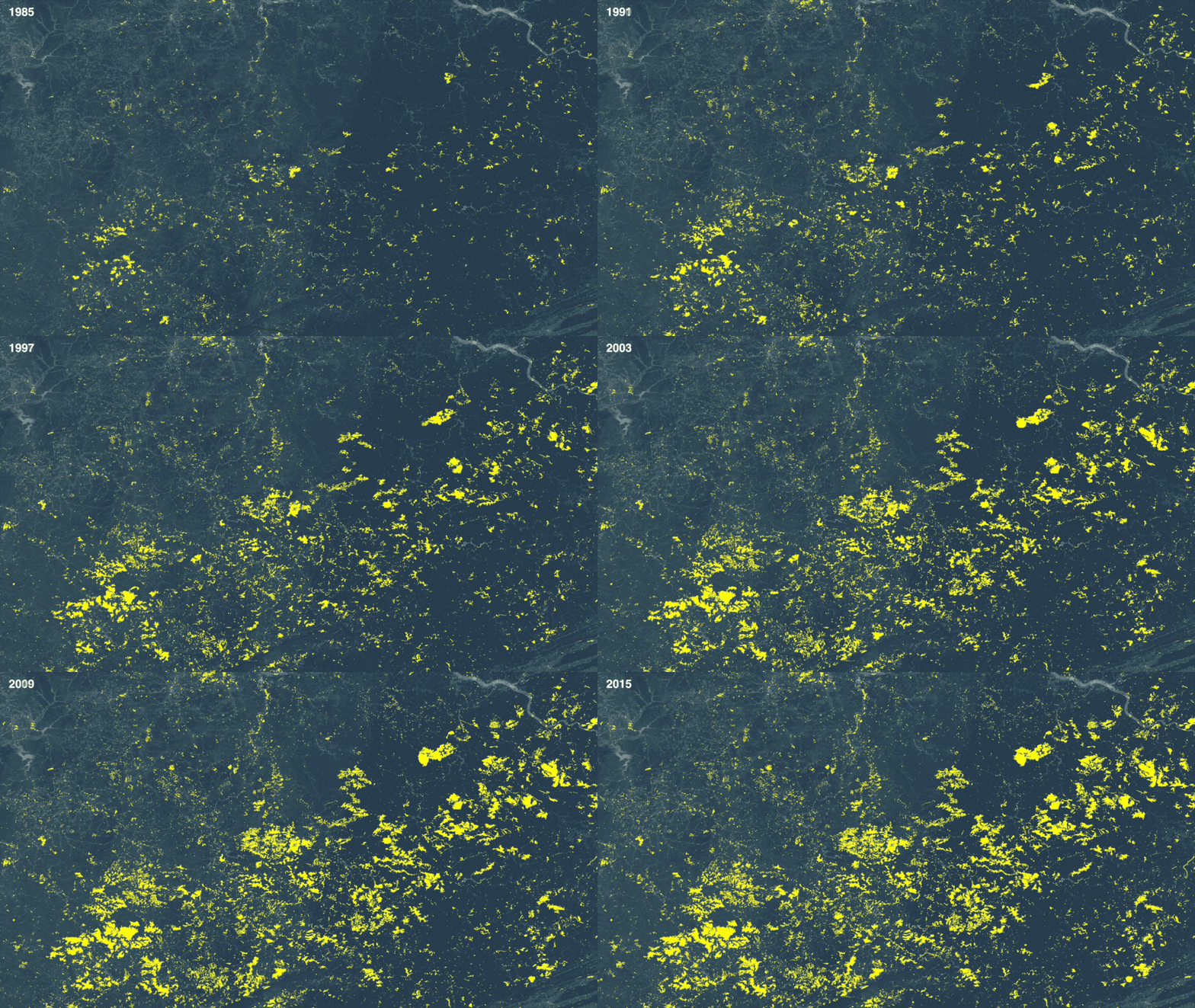
Expansion of surface coal mining across Central Appalachia 1985-2015 (source)
Check out this and other data visualization apps that document the impacts of MTMVF by visiting our DataViz page
|
Bernhardt and Brian McGlynn were coPIs of this four year NSF Hydrology grant to study the topographic, hydrologic, biogeochemical and biodiversity impacts of mountaintop removal coal mining. Over the course of four years we mapped the total extent of MTMVF mines (Pericak et al 2018), estimated the extent of topographic flattening and the volume of 1544 valley fills (Ross et al. 2016) and used paired catchment studies to document dramatic shifts in stream hydrographs (Nippgen et al 2017) and rates of rock weathering derived solute exports (Ross et al. 2018) from mined watersheds. We also looked at the impacts of MTMVF on biodiversity using techniques that ranged from intensive measurements of secondary production in a few streams (Voss et al. 2017), aquatic insects and riparian spider surveys across the Mud River valley (Gerson et al. 2020 Naslund et al. 2020, 2021), microbial community composition and a large scale eDNA survey across a gradient of mining activity throughout the region (Bier et al. 2015, Bier et al. 2020, Simonin et al. 2021).
Lab alumni Marie Simonin, Jackie Gerson, Laura Naslund, Matt Ross, Andrew Pericak, Alex Brooks, Kris Voss, Raven Bier and Brian Lutz all conducted some portion of their research on this topic during their time in the #DukeBGC lab. |
